
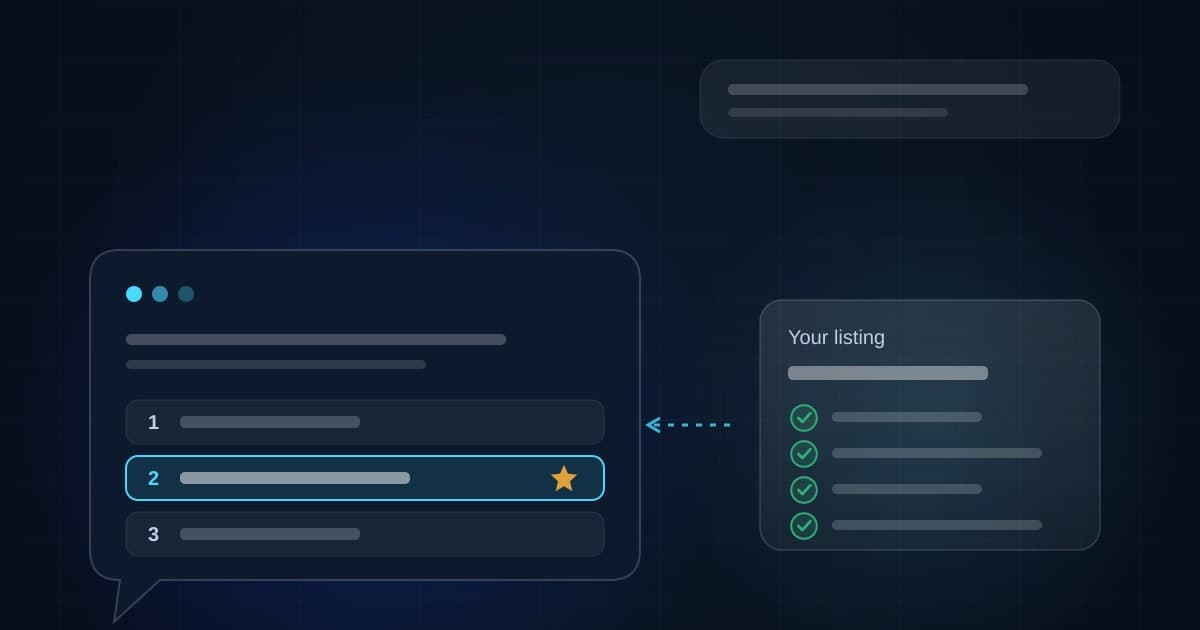
Open ChatGPT and type the question your next customer is going to type. "Best HVAC company in Longview TX." "Who does land clearing near Tyler." "Dental assistant school near me."
Three or four businesses come back with a sentence about each. Either you are one of them or you are not.
I do this for clients before we build anything, because it tells you what the machine believes about you today. This article is what we have learned about where those answers come from and what to publish so they come out right. No tricks, because there are none that last.
How many people are actually asking
BrightLocal's Local Consumer Review Survey 2026, published in March, put a number on it: 45 percent of US consumers said they had used an AI tool for local business recommendations in the past year, up from 6 percent the year before. ChatGPT was the most used tool at 31 percent.
How many people ask AI for a local recommendation
Share of US consumers surveyed, Local Consumer Review Survey 2026 (1,002 adults).
Up from 6 percent the year before.
The most used tool in the survey.
Reviews still close the loop.
| Item | Value |
|---|---|
| Used an AI tool for local business recommendations in the last year | 45% |
| Used ChatGPT specifically | 31% |
| AI users who double-check recommendations against real reviews at least sometimes | 97% |
Source: BrightLocal, Local Consumer Review Survey 2026, published March 10, 2026.
The third bar is the one to remember. Almost everyone who gets an AI recommendation checks it against real reviews at least sometimes. So the AI opens the door and your reviews decide whether the customer walks through. Both halves have to be right.
Where ChatGPT gets its local answers
This is the part most articles skip because it takes work to find out.
A researcher named Nicolas Sitter tracked roughly 25,600 ChatGPT hotel searches between December 2025 and March 2026, close to 100,000 map pins. In December, every pin came from Google Places. By the last week of March, Google Places supplied 70 percent, Yelp 22 percent, and Foursquare and Tripadvisor the rest. SocialPlaces published the breakdown in August.
Where ChatGPT's local map pins came from
Share of hotel map entities by data provider, last tracked week of March 2026. Hotels, not every trade.
In December 2025 it was all of them.
| Item | Value |
|---|---|
| Google Places | 70.3% |
| Yelp | 22.4% |
| Foursquare, Tripadvisor and others | 7.3% |
Source: Nicolas Sitter's tracking of about 25,600 ChatGPT hotel searches, December 2025 to March 2026, as reported by SocialPlaces on August 19, 2026. The article notes it is unclear whether services follow the same pattern.
Hotels are not plumbers, and the article says so. But the lesson transfers: ChatGPT is not inventing a list of businesses. It is reading the same listings Google Maps reads, plus review sites, plus whatever it can crawl on your website. If your Google Business Profile is thin, you are thin everywhere that reads it.
Google itself now sells the same idea back to you. Its Business Agent for leads answers customer questions inside Search, and Google's own page says the agent is grounded in your website. The machine's script is your site.
What we publish for clients, in order
1. One listing, complete, that you own. Same business name, address and phone everywhere. Hours that are true. Every service listed with a sentence. Photos from this year. Replies on reviews. The owner's own Google account on it, with a second trusted owner. This is the source most assistants start from, so it goes first.
2. A website that answers questions in plain words. A machine cannot summarize "quality service at a fair price." It can summarize "Service calls are $89. Most repairs run $250 to $900. We cover Gregg, Harrison and Upshur counties. Same-week appointments." Every service page we build has a price or a range, an area, a timeline, and what is included, written the way the owner says it on the phone.
3. The five questions, answered, on the page, with markup. Price, area, timing, what is included, how to book. Visible on the page for people, marked up as questions and answers for machines. The tool below writes the markup. You write the answers.
Turn the questions customers ask you into answers a machine can quote
AI assistants recommend businesses they can describe. The fastest way to become describable is to publish the five questions every customer asks you, with plain answers, and mark them up so a machine knows they are questions and answers. This tool writes that markup. You paste it on the page. It does not make a page rank, and it cannot invent answers you have not written.
Your details
Put the question, then a pipe character, then the answer. One pair per line.
Your draft
Your FAQ schema
<script type="application/ld+json">
{
  "@context": "https://schema.org",
  "@type": "FAQPage",
  "mainEntity": [
    {
      "@type": "Question",
      "name": "Do you charge for estimates?",
      "acceptedAnswer": {
        "@type": "Answer",
        "text": "No. Estimates are free and we usually get to you within 24 hours."
      }
    },
    {
      "@type": "Question",
      "name": "What areas do you serve?",
      "acceptedAnswer": {
        "@type": "Answer",
        "text": "We cover Longview, Marshall, Kilgore, Gladewater and the surrounding area."
      }
    },
    {
      "@type": "Question",
      "name": "Are you licensed and insured?",
      "acceptedAnswer": {
        "@type": "Answer",
        "text": "Yes. We are fully licensed and insured, and we will show you the paperwork any time you ask."
      }
    },
    {
      "@type": "Question",
      "name": "How fast can you get out here?",
      "acceptedAnswer": {
        "@type": "Answer",
        "text": "Same day for emergencies, usually next day for everything else."
      }
    },
    {
      "@type": "Question",
      "name": "Do you offer payment plans?",
      "acceptedAnswer": {
        "@type": "Answer",
        "text": "Yes, on larger jobs. Just ask when we quote it."
      }
    }
  ]
}
</script>

<!-- Visible version for the page -->
<h3>Do you charge for estimates?</h3>
<p>No. Estimates are free and we usually get to you within 24 hours.</p>

<h3>What areas do you serve?</h3>
<p>We cover Longview, Marshall, Kilgore, Gladewater and the surrounding area.</p>

<h3>Are you licensed and insured?</h3>
<p>Yes. We are fully licensed and insured, and we will show you the paperwork any time you ask.</p>

<h3>How fast can you get out here?</h3>
<p>Same day for emergencies, usually next day for everything else.</p>

<h3>Do you offer payment plans?</h3>
<p>Yes, on larger jobs. Just ask when we quote it.</p>
5 questions found
| Question | Answer |
|---|---|
| Do you charge for estimates? | No. Estimates are free and we usually get to you within 24 hours. |
| What areas do you serve? | We cover Longview, Marshall, Kilgore, Gladewater and the surrounding area. |
| Are you licensed and insured? | Yes. We are fully licensed and insured, and we will show you the paperwork any time you ask. |
| How fast can you get out here? | Same day for emergencies, usually next day for everything else. |
| Do you offer payment plans? | Yes, on larger jobs. Just ask when we quote it. |
The questions and answers in the schema must actually appear on the page for a visitor to see. Do not put schema on a page that does not show the same content.
What this assumed
- Only mark up questions that are actually visible on the page. Hidden FAQ markup is a manual action waiting to happen.
Runs in your browser. Nothing you type is sent anywhere.
How to run it, step by step
- 1Write the five questions customers ask before they buy. Price, area, timing, what is included, and how to book. Use the words they use on the phone, not your trade's words. 'How much does a service call cost' beats 'diagnostic fee structure'.
- 2Answer each one in two to four plain sentences. Give a number or a range when there is one. Give a day count when there is one. If the honest answer is 'it depends', say what it depends on in one sentence and give the typical case.
- 3Generate the markup and paste it on the page that shows those answers. The markup has to match text that is visible on the page. Put the questions and answers on the page for people first, then add the code. Markup for answers that are not on the page is the kind of thing search engines penalize.
How to read what it gives you
- The output is a block of code, not a ranking. It helps a machine read what you already published. The writing is the work.
- If you could not answer a question with a number, a range, or a day count, that is the question customers call about, and the question the AI will answer badly for you until you fix it.
- Put the same answers on your Google Business Profile in the Q&A and services sections. The assistant reads both.
The tool is free, it does not expire, and you can put it on your own website if you want it there. Nothing on this page is locked.
Not ready to talk? Browse the rest of the free tools
4. Reviews that say something. Ask every happy customer, and ask them to say what was done and what it cost if they are comfortable. "Great job" is a rating. "Replaced our water heater the same afternoon for $1,400" is a sentence a machine can quote. We wrote the asking script in how to ask for an honest review after the work is done.
5. The same answers on your Business Profile. Services with descriptions, the Q&A section seeded with your five questions, and a post when something changes. The assistants read the profile and the site. Make them agree.
6. Run the test monthly. Same three questions, ChatGPT and Google, screenshot the results. You are not watching rankings. You are watching whether the machine's description of you is accurate. The day it says you charge a price you stopped charging two years ago, you know which page to fix.
What this costs and what it does not do
Everything above is writing and listing work. There is no software to rent. If you have an afternoon, you can do the listing and the five questions yourself. If you want it done and kept current, that is what we do, and the form above is how you ask.
It does not promise a position in anyone's answer. SOCi's 2026 Local Discovery Index found two thirds of AI users have gotten wrong information about a local business at least once, which tells you how much of this is still rough. The businesses that publish clear facts are the ones the rough edges hurt least.
The bottom line
ChatGPT recommends businesses it can describe accurately from public sources it already reads. Make your Google listing complete, publish prices and scope in plain words on a site you own, answer the five questions, collect reviews that say what happened, and check the machine's work every month.
That is the whole method. It is not clever. It is the same thing that made your business findable on Google ten years ago, written for a reader that now talks back.
Questions people actually ask
Can I pay to be recommended by ChatGPT?
Not for the organic recommendation. OpenAI has started selling ads inside ChatGPT, and those are labeled as ads. The recommendation itself comes from what the model can find about you: your Google Business Profile, your reviews on Google and Yelp, and the plain text on your website. Nobody can sell you a shortcut into that, and anyone who says they can is selling the same listing-management pitch with a new name.
Does ChatGPT read my Google reviews?
In the tracking SocialPlaces reported, Google Places supplied most of ChatGPT's local pins, and Yelp supplied most of the rest. Both carry reviews. Treat your reviews as part of your public description: recent, specific, and replied to. A review that says 'fixed our AC the same day, $340 all in' is a sentence a machine can repeat.
How long before AI recommendations change?
Nobody can give you a date, and we do not promise one. Listings update fast, often within days. Website changes are picked up when the pages are crawled again, which depends on how often your site changes and who links to it. Publish the answers, keep the listing current, and run the test every month.
What should I NOT do?
Do not stuff your pages with 'best plumber in Tyler TX' twenty times. Do not post fake reviews, which is illegal under the FTC's 2024 rule on fake reviews and testimonials and is exactly the kind of pattern these systems learn to discount. Do not hide your prices behind 'call for a quote' if you can publish a range. And do not buy a listing in a 'voice assistant directory' from someone who called you.
Where these numbers come from
- BrightLocal: Local Consumer Review Survey 2026, AI and trust (March 10, 2026)
- SocialPlaces: ChatGPT Maps tab, where the pins come from (August 19, 2026)
- SOCi 2026 Local Discovery Index, as summarized by SEOteric (October 5, 2026)
- Google: Business Agent for leads (updated August 26, 2026)
Our own figures come from the lead records of businesses we run systems for, counted in total and never by name.