
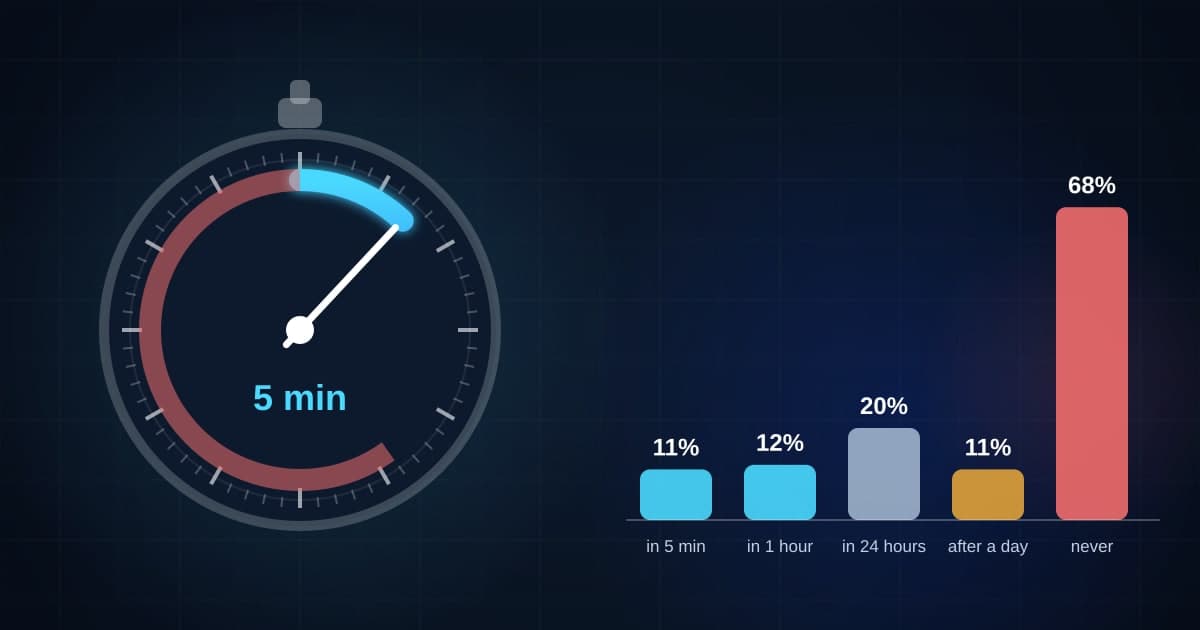
Every article about lead follow-up quotes the same study. Call back inside five minutes and your odds of reaching the person are many times higher than at thirty. It is a real study and the shape holds up.
What nobody quotes is how far the average small business is from it. So we counted.
Between September 18 and October 7, 2026, 202 new leads reached the businesses we run systems for: calls, forms, texts and ad leads. We looked for the first outbound call or text logged against each one and how long it took. Here is what came back.
How long 202 real leads waited for the first call or text back
New leads, September 18 to October 7, 2026, across the businesses we run systems for. Email-only follow-up is not counted as a touch.
22 of 202.
24 of 202. Almost everyone who was going to be fast was fast in the first five minutes.
41 of 202.
23 of 202.
138 of 202. Some got an email. None got a phone call or a text we can find.
| Item | Value |
|---|---|
| Called or texted within 5 minutes | 11% |
| Within 1 hour (cumulative) | 12% |
| Within 24 hours (cumulative) | 20% |
| First touch came after 24 hours | 11% |
| No call or text on record at all | 68% |
Source: our own lead records, counted in total across two businesses. The window starts September 18 because that is when every outbound text began to be logged, so earlier months would undercount.
Read that bottom bar twice. Sixty-eight percent of new leads have no phone call and no text on record. Some of them got an email. Some of them got nothing. The person asked, and the business never picked up the phone.
I am not writing this from a high horse. One of those businesses is mine. The point is not that owners are lazy. The point is that follow-up is a system, and when there is no system, this is what the numbers look like for almost everyone.
What the fast group looks like
The most interesting number is the gap between five minutes and one hour: 11 percent and 12 percent. Almost nobody who called back in the first hour did it between minute six and minute sixty. Either the business reached the lead almost instantly, or it did not reach them that hour at all.
That is what a system looks like in the data. The fast touches are automatic texts and a person who happened to be at the desk. The slow touches are humans getting to it later.
Does speed change the reply rate?
We checked who wrote back.
Who wrote back, by how fast we reached them
Share of leads that replied by call or text, grouped by the speed of our first touch. Small groups, read the direction, not the decimals.
8 replied.
4 replied.
| Item | Value |
|---|---|
| First touch inside an hour (24 leads) | 33% |
| First touch after 24 hours (23 leads) | 17% |
Source: the same 202-lead window. Two dozen leads in each group is enough to see a direction and not enough to quote as a statistic.
Two dozen leads in each group is a small sample, and I am not going to pretend a third versus a sixth is a law of nature. But it points the same direction as every larger study: reach someone while they are still deciding and they talk to you. Reach them tomorrow and half of them already talked to someone else.
Why this happens to good businesses
The lead arrives while you are working. Most inquiries come in late morning and early afternoon, which is exactly when the owner is on a roof or in a chair. Nobody owns the phone, so nobody answers it.
The notification goes somewhere nobody looks. Form submissions land in an inbox checked at night. Facebook leads sit in a tab nobody opens. Google messages go to an app nobody installed.
The ad was set up without a follow-up plan. Money went into the campaign. Nothing went into what happens the minute a lead arrives. We see this most with ad leads, and it is the easiest to fix because the platform tells you the instant someone fills the form.
Nobody wrote down what the first reply says. When the reply has to be composed from scratch, it waits for a quiet moment. Quiet moments come at 9 PM.
The fix, in order of cheapness
1. An automatic text inside a minute, from your business line. It says who you are, that you got the message, and what happens next. It is not the sale. It is the thing that keeps the person from dialing the next company. We wrote the script in how to write a missed call reply that tells people what happens next.
2. One place every lead lands. Calls, forms, Facebook, Google, all in one list with the time it arrived and who owns it. Not six apps. If you want the reasoning, read give every inquiry an owner and a next step.
3. A person who owns the phone from 8 to 5. That can be you with the ringer on, a family member, an office hire, or a shared answering line. Decide who, write it down, and make the list from step two their job.
4. A daily call queue. Every lead that did not get a human touch yesterday is a call today, in order, before anything else. Ten minutes a day clears most small businesses' backlog.
5. Measure it monthly. Count the leads, count the ones touched inside an hour, count the ones never touched. The number you watch is the one that moves.
Run your own numbers first. The calculator below uses the published research to show what your current response time is costing against your ticket and close rate.
See what your own callback speed is costing
The calculator takes your monthly lead count, how long it usually takes you to respond, your average ticket and your close rate, and shows what a faster reply would be worth. It uses the published research on contact rates by response time. It cannot see your phone, so be honest about the hours.
Start from your industry
Editable starting examples for your industry. They change the starting numbers, not the math, and they are not industry statistics.
Your numbers
What that means
Same assumed leads and value, with an unvalidated decay curve.
Set a realistic reply commitment, give each inquiry an owner, and record the first helpful response. An automated acknowledgment does not complete the conversation.
Illustrative sensitivity model, not observed results or a validated response-time benchmark. The exponential curve and 12% floor are assumptions. A five-minute comparison uses exactly 5/60 of an hour. An automated acknowledgment is not a completed helpful human response.
What this assumed
- The exponential curve is an arbitrary sensitivity model, not a validated benchmark or causal evidence.
- The 12% floor is an unvalidated assumption, not a measured conversion rate.
- Your entered base close rate is multiplied by the hypothetical time factor; an automated acknowledgment is not a helpful completed response.
Runs in your browser. Nothing you type is sent anywhere.
This is an estimate
This tool returns an estimate based on the numbers you entered. Your real result depends on your own costs, rates and conditions. Check it against your own records before you make a decision with it.
How to run it, step by step
- 1Count last month's new inquiries. Calls, forms, messages and texts from new people. Not repeat customers. If you do not know, pull your call log and your form notifications for one month and count.
- 2Enter your real response time in hours. Not your best day. The typical gap between the inquiry and the first call or text back. If forms sit until the evening, that is eight or ten hours. If calls go to voicemail and get returned the next morning, that is sixteen.
- 3Use the ticket and close rate you actually see. Average job value is a typical first invoice. Close rate is the share of real inquiries that become paid work at your current speed, which is the number the calculator improves on.
How to read what it gives you
- The gap between your current line and the five-minute line is money you are paying to be slow. It is also the budget for fixing it: a text-back, a shared line, or a person for the busy hours.
- If your response time is already under an hour, the calculator will show a small gap. Good. Protect it, because the number creeps up as you get busier.
- Treat the result as a direction, not a forecast. The research is about contact rates. Your close rate still depends on the quote.
The tool is free, it does not expire, and you can put it on your own website if you want it there. Nothing on this page is locked.
Not ready to talk? Browse the rest of the free tools
What this does not prove
It does not prove that speed alone closes jobs. The quote still has to be right and the work still has to be good. It does not prove anything about your trade in your town, because it is two businesses in East Texas over three weeks. And it does not say owners do not care. It says the phone needs an owner, and most businesses have not given it one.
The bottom line
Two thirds of the leads in our own records never got a call or a text. One in nine got one inside five minutes. The gap between those two numbers is the cheapest revenue most small businesses will ever find, and the fix starts with a sixty-second text and one person who owns the phone.
If you want that built and running on a line you own, the form above is how you ask. If you want to see the cost first, the calculator is right there.
Questions people actually ask
Is the five minute rule real?
The research behind it is real and old. The Lead Response Management Study found the odds of making contact with a web lead fell sharply after five minutes and kept falling by the hour. Newer studies keep finding the same shape. What our own count adds is how far most small businesses are from it: one in nine leads got a call or text inside five minutes, and two thirds got none at all.
Why did two thirds of leads get no call or text?
Three reasons we see over and over. The lead arrived while the owner was working and nobody else owned the phone. The form notification went to an inbox that is checked at night. And the lead came from an ad on a platform where the owner never set up a notification at all. None of those are laziness. They are the absence of a system, and a system is a cheap thing to add.
Does a text count, or does it have to be a call?
A text within a minute beats a call within an hour, because the text arrives while the person is still holding the phone they used to reach you. We count both as a first touch. The best setup does both: an automatic text that says who you are and what happens next, then a call from a person inside the hour.
How did you count this, and why only 202?
We pulled every new lead that reached two businesses we run systems for between September 18 and October 7, 2026, and looked for the first outbound call or text logged against each one. September 18 is when every outbound text started being recorded, so earlier months would have made the numbers look worse than they were. Nobody is named, and nothing in the count identifies a customer. It is a small window on purpose: it is the one we can vouch for.
Where these numbers come from
- Lead Response Management Study, James Oldroyd (contact and qualification odds by response time) (2007)
Our own figures come from the lead records of businesses we run systems for, counted in total and never by name.