
A contractor asked me last week what a land clearing lead should cost. He had been quoted a price per lead by a lead service and had no way to tell if it was fair.
The honest answer is that I can tell you what ours cost, and then I can show you the three numbers that decide whether that price is cheap or expensive for you. Nobody can skip the second part, and anyone who quotes you a flat "good" cost per lead is selling you something.
What ours actually cost
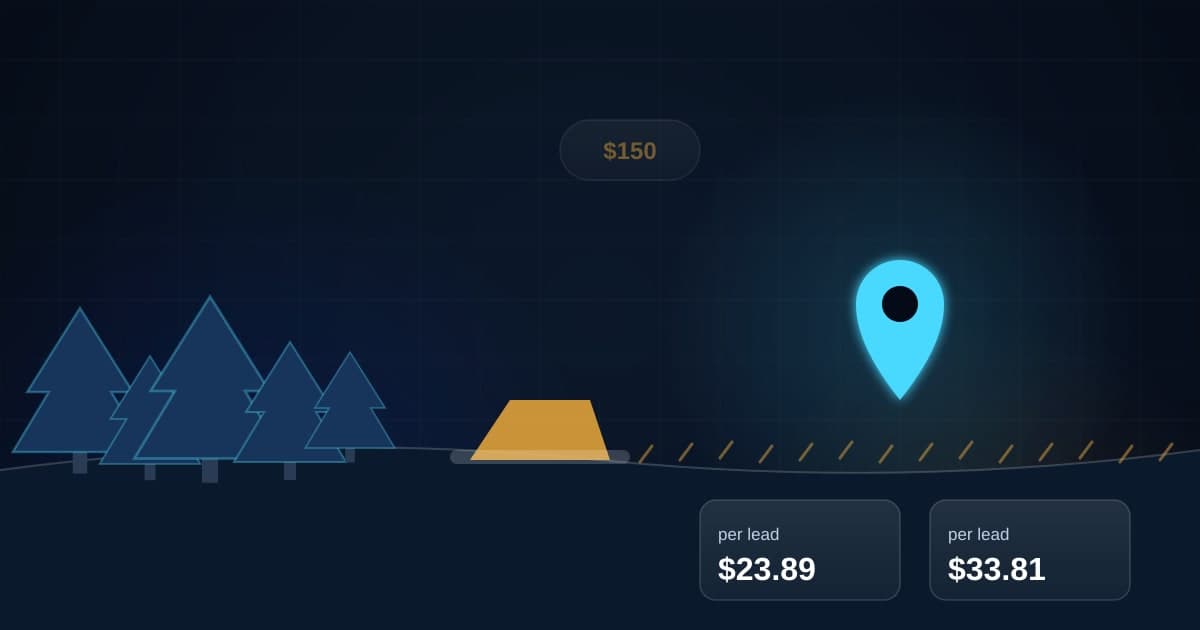
We run a Meta campaign for a land clearing and dirt work client in East Texas. The ad account numbers are ours to report; the client stays unnamed. In the first days the campaign spent $47.77 and produced two leads, which is about $24 a lead. The next week a dirt work lead came in at $33.81.
What leads cost on one East Texas land clearing campaign
Cost per lead at three points. One client, one campaign, Meta instant forms, October 2026.
Early leads are cheap because the audience is fresh and the first responders are the most interested.
The cost of that one lead on the day it came in.
Our planning figure for this trade in this market, the top of a $125 to $150 range. Not a result, a budget.
| Item | Value |
|---|---|
| First two leads (first days, $47.77 spent) | $23.89 |
| A single dirt work lead the following week | $33.81 |
| What we budget once the easy ones are gone | $150 |
Source: an ad account we manage for a land clearing client in East Texas, October 2026, totals only and no names. Early costs are real; the $150 is what we plan on, not what we promise.
Here is the part the lead services leave out. Those first leads are cheap because the audience is fresh. The platform shows the ad to the people most likely to respond, and the most interested ones answer first. As they get used up, every additional lead costs more to find. So we do not plan on $24 or $34. For this trade in this market we budget $125 to $150 a lead once the easy ones are gone, and we judge the campaign on week three, not day three.
If a lead service is quoting you $40 flat for land clearing leads, ask whether they are shared with other contractors and how old they are. Exclusive, fresh, local leads in a trade with $2,000 tickets do not cost $40 for long.
The three numbers that decide if $150 is cheap
Close rate on quoted jobs. Of the last twenty people you quoted, how many hired you? Land work closes lower than a service call because the ticket is bigger and people get three bids. One in four is respectable. One in eight means the quote process needs work before the ad budget does.
Typical job value. The median invoice across your last ten jobs. Not the $9,000 pad. The $2,400 brush and stump job you do most weeks.
Gross margin. What you keep after fuel, the operator and machine time. The machine counts even if it is paid off, because an hour on the dozer is an hour of its life.
Is a $150 lead expensive? It depends on three numbers you already have.
A worked example: $150 per lead, one job in four closes, $2,400 typical job, 40 percent margin.
Before any repeat work or the neighbor who calls next spring.
| Item | Value |
|---|---|
| Cost to get one paying customer (4 leads at $150) | $600 |
| Gross profit on the typical job ($2,400 at 40%) | $960 |
| Left after the cost of getting the job | $360 |
Illustrative arithmetic only. Source: arithmetic in this article. Practice numbers for your calculator to replace.
That chart is practice arithmetic, not anyone's account. At a $150 lead, one in four closing, a $2,400 job and 40 percent margin, you pay $600 to land a customer and keep $360 on the first job. If your close rate is one in eight, the same lead costs you $1,200 per customer and the first job loses money. Same ad, same lead price, opposite result. The difference is entirely in your three numbers.
Put yours in the calculator.
Work out what one land clearing lead is worth to you before you buy any
Cost per lead means nothing until you know what a lead is worth. This calculator takes your close rate, your average job, your margin, repeat work and referrals, and tells you what a new inquiry is worth and how much you can pay for one. Use the numbers from your last ten jobs, not the best one.
Start from your industry
Editable starting examples for your industry. They change the starting numbers, not the math, and they are not industry statistics.
Your numbers
What that means
The acquisition cost is below the illustrative allocation. Check cash timing, actual delivery costs, and observed customer behavior before increasing spending.
Scenario assumes every referred customer has the same first and repeat purchases. It excludes recursive referrals, overhead, refunds, timing, and discounting. The 40% allocation is arbitrary; average gross contribution is not cash available today.
What this assumed
- Lead value is gross profit per lead, not revenue per lead.
- Repeat purchases are counted at the same margin as the first sale.
Runs in your browser. Nothing you type is sent anywhere.
This is an estimate
This tool returns an estimate based on the numbers you entered. Your real result depends on your own costs, rates and conditions. Check it against your own records before you make a decision with it.
How to run it, step by step
- 1Use your close rate on quoted jobs. Of the last twenty people you quoted, how many hired you? That is the number. Land clearing closes lower than service calls because the tickets are bigger and people shop. Be honest; the tool only works with the real rate.
- 2Enter a typical job, not a dream job. The median invoice across your last ten jobs. If pads and ponds run $4,000 and brush clearing runs $1,200 and you do more clearing, the typical job is closer to $1,200.
- 3Use the margin after fuel, operator and machine time. Gross margin is what you keep after the direct cost of running the job. Equipment payments count even when the machine is yours, because an hour on the dozer is an hour of its life.
- 4Add repeat and referral only from your own history. Landowners who clear five acres this year often clear five more next year, and they talk to neighbors. Count what has actually happened on your past jobs, or enter zero and let the result be a floor.
How to read what it gives you
- The value of a lead is what you can afford to pay for one and still make money. If it is $300 and leads cost $150, the ads work. If it is $90, they do not, and the fix is the close rate or the price, not the ad.
- Repeat and referral value is where land work gets interesting. One cleared property that turns into a pond, a road and a neighbor's job is worth several first jobs.
- A low number means tighten the quote process before spending on leads. More inquiries into a slow quote is money into a bucket with a hole in it.
The tool is free, it does not expire, and you can put it on your own website if you want it there. Nothing on this page is locked.
Not ready to talk? Browse the rest of the free tools
The repeat and referral part most contractors undercount
Land work is unusual. A landowner who clears five acres often clears five more the next year. The cleared lot becomes a pad, the pad needs a road, the road needs culverts, and the neighbor watched the whole thing from the porch.
If your history says one in three first jobs turns into a second one, a $600 cost per customer is buying a lot more than $2,400 of work. Count it from your own past jobs and put it in the calculator. If you have never tracked it, enter zero and treat the result as a floor.
How we run it so the numbers hold
The client owns the ad account and pays the spend on his own card. The audience, the pixel, the history, all his. If he ever fires us, he keeps the asset.
Instant forms with two qualifying questions. Acreage and timing. The tire kickers sort themselves out before the phone rings.
A text inside a minute and a call inside the hour. A land clearing lead that waits until tomorrow is talking to another contractor by lunch. We showed what that costs across 202 real leads in how fast do small businesses actually call leads back.
Video from the seat of the machine. The ads that produce cheap leads in this trade are the owner talking from the cab, not a stock photo of an excavator. Thirty seconds, phone camera, honest.
A website that shows the work. The forms start the relationship. The site is where the serious landowner goes to see the pond you dug last spring before he calls. That is what moves the close rate, which is what moves every other number here.
What this does not tell you
It does not tell you what leads cost in your county this month. It does not promise any number of leads or jobs; nobody can, and the budget line in the chart is a budget, not a result. And it does not help if the quotes go out three days late. Fix the follow-up first. Then buy leads.
The bottom line
On our campaign the first land clearing leads cost under $35 and we budget $125 to $150 after that. Whether that is cheap depends on your close rate, your typical job and your margin, and the calculator tells you in two minutes. If the lead is worth more than it costs, run the ads from an account you own. If it is not, the problem is the quote, not the lead.
Questions people actually ask
What is a good cost per lead for land clearing?
There is no number that is good on its own. A $150 lead is cheap for a business that closes one in four at $2,400 a job, and expensive for one that closes one in twelve at $900. On the campaign in this article the first leads came in under $35 each, and we budget $125 to $150 once the early audience is used up. Work out what a lead is worth to you with the calculator, then compare.
Why do the first leads cost less than the later ones?
When a campaign starts, the platform shows the ad to the people most likely to respond, and the most interested people respond first. As those get used up, each additional lead costs more to find. Judge a campaign on its third and fourth week, not its first three days, in either direction.
Should I use Facebook instant forms or send people to my website?
Instant forms produce more leads at a lower cost because the person never leaves Facebook. They also produce more tire kickers. A website form produces fewer, more serious leads and builds a site you own. We run forms to start, add qualifying questions so the serious ones sort themselves, and build the website so the business is not renting its lead flow forever.
Who should pay for the ad spend, me or the agency?
You, on your own card, in your own ad account, with the agency managing it. Then the account, the audience data and the history are yours if you ever change agencies. An agency that insists on running your ads from its account is keeping your results as its property.